Most contractors who say "marketing doesn't work" aren't wrong about their results — they're wrong about the diagnosis. The problem isn't marketing. It's that they were using the wrong kind.
Key Takeaways
- Remodeling marketing is a distinct discipline — not general digital marketing applied to contractors. The homeowner buying cycle demands a specialized approach built around trust, timeline, and project value.
- Most contractors are invisible at the critical early stages of the homeowner buying journey, spending budget only at the bottom of the funnel where competition is highest and margins are thinnest.
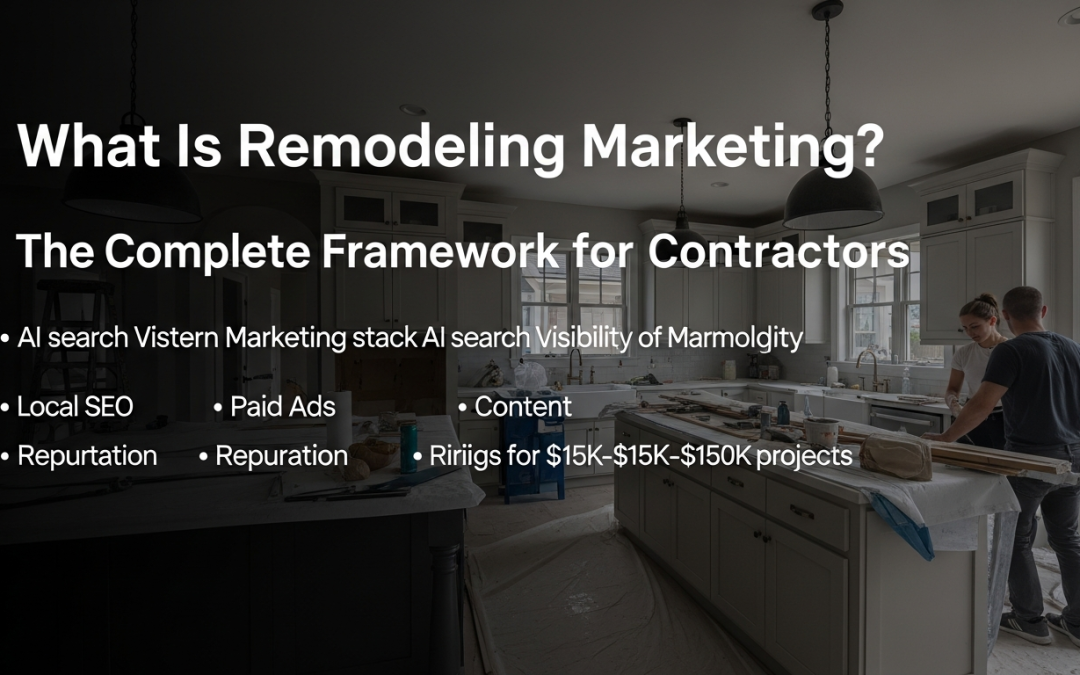
- A modern remodeling marketing framework has five pillars: Local SEO and Google Business Profile, AI Search Visibility, Paid Advertising, Content and Topical Authority, and Reputation and Social Proof.
- AI search visibility is no longer optional. Google's AI Overviews are actively filtering which contractors get recommended, and most remodelers have no strategy to influence that output.
- The right marketing mix depends on your business stage, service type, and growth goals — not on what worked for a plumber or a national home services brand.
- SEO builds authority over 3–6 months; paid ads can generate leads in weeks. Both are necessary — but deploying them in the wrong sequence wastes budget and damages brand perception.
- Reputation is a marketing channel, not an afterthought. For $50K–$150K remodeling decisions, homeowners read reviews the same way they read references — thoroughly and skeptically.
- Generic marketing agencies fail remodelers because they optimize for volume metrics rather than the high-value, long-consideration projects that actually grow a remodeling company.
Quick Answer: What Is Remodeling Marketing?
Remodeling marketing is the strategic discipline of attracting, nurturing, and converting homeowners who are planning high-value renovation projects — typically ranging from $15,000 to $150,000 or more. Unlike generic digital marketing, it accounts for the extended homeowner consideration cycle, the trust-intensive nature of hiring someone to work inside your home, and the hyper-local competitive dynamics of the contracting industry. An effective remodeling marketing strategy combines local SEO, AI search visibility, paid advertising, content authority, and reputation management into a unified system designed to generate qualified project leads — not just website traffic.
What Is Remodeling Marketing? (And Why Generic Marketing Fails Contractors)
Here's the hard truth: the marketing playbook that works for an e-commerce brand, a restaurant, or even a national home services franchise will actively hurt a remodeling contractor. The tactics are structurally mismatched. Chasing impressions, follower counts, and cost-per-click benchmarks built for commodity services are worse than useless when you're trying to win a $60,000 kitchen remodel.
Remodeling marketing is a niche discipline because the product — a major renovation — is not an impulse purchase. A homeowner doesn't decide to spend $80,000 on a design-build addition after seeing one Facebook ad. The decision cycle can span six to eighteen months. It involves Pinterest boards, YouTube research, neighbor referrals, three contractor consultations, and a final gut-check moment where trust either exists or it doesn't.
Generic digital marketing agencies optimize for what they can measure quickly: clicks, impressions, social engagement. None of those metrics tell you whether a $120,000 master suite addition is in your pipeline next quarter. Marketing for remodelers has to be built around the actual decision architecture of the homeowner — and that requires specialization, not repurposed templates. As detailed in our analysis of the most damaging mistakes contractors make when marketing their remodeling companies, misaligned strategy is the single biggest driver of wasted marketing spend in this industry.
Why High Project Value Changes Everything
When a homeowner is spending $15,000 on bathroom tile work, they're cautious. When they're spending $150,000 on a whole-home renovation, they are forensically thorough. They will Google your company name, read every review, visit your website three times, look you up on Houzz and Angi, and ask their neighbor who you are. Every single one of those touchpoints is a marketing moment — and most contractors are only intentionally managing one or two of them.
That's the structural problem remodeling marketing exists to solve. It's not about getting more traffic. It's about building a presence that holds up to scrutiny at every stage of a $50,000+ buying decision. That requires a completely different framework than what a general digital marketing agency provides.
The Homeowner Buying Journey: What You’re Actually Marketing Against
To build a marketing strategy that works, you have to understand the homeowner's actual decision process — not the idealized funnel marketers draw on whiteboards. The remodeling buying journey has five distinct stages, and most contractors are only visible in the last two.
Stage 1: Dream and Inspiration
This is where the project begins — in a homeowner's head, months or years before any contractor is contacted. They're pinning kitchen ideas on Pinterest, watching renovation reveals on YouTube, and scrolling Instagram for bathroom inspiration. They have no timeline and no budget. But they're forming preferences, aesthetic standards, and brand impressions that will filter every contractor they eventually consider.
Contractors who are visible at this stage — through compelling project photography, social content, and aspirational before-and-afters — get mentally shortlisted before the research phase even begins. Contractors who only run Google Search ads are nowhere in this conversation.
Stage 2: Research and Education
The homeowner starts actively searching. They want to know what a kitchen remodel costs in their city, how long it takes, what they should ask a contractor, and what the process looks like. This is an education-driven stage, and the contractors who publish content that answers these questions become trusted authorities — not just vendors.
If your website has no educational content and your blog hasn't been updated since 2021, you are invisible here. You're not even competing for the consideration that happens before comparison shopping begins.
Stages 3–5: Shortlisting, Vetting, and Hiring
This is where the majority of contractor marketing dollars go — Google Search ads, Local Service Ads, Houzz listings. The homeowner is now actively comparing three to five contractors. Price matters, but it's not the deciding factor at high project values. What closes the deal is trust, credibility, and social proof. Reviews, project galleries, professional websites, and responsiveness all become conversion variables.
The fatal mistake is spending your entire budget here and nowhere else. You're competing against every other contractor who also only runs bottom-funnel ads, which drives up cost-per-click and degrades lead quality. A full-funnel remodeling marketing strategy creates familiarity at stages one and two so that by stages three through five, you're not an unknown commodity — you're the expected choice. Understanding this complete arc is explored in depth in our guide to customer journey mapping for remodeling contractors from awareness to advocacy.
The 5 Pillars of a Modern Remodeling Marketing Framework
Every effective marketing strategy for a remodeling contractor is built on five interconnected pillars. Removing any one of them creates a gap that competitors — or the algorithm — will fill.
- Local SEO and Google Business Profile. For remodelers, local search is the foundation. Homeowners search "kitchen remodeling contractor near me" or "bathroom remodel [city name]" — and if your Google Business Profile isn't optimized and your website doesn't rank for local intent keywords, you don't exist to that buyer. Local SEO includes citation consistency, proximity signals, review volume, and on-page optimization for service-plus-location keyword combinations. The contractor outcome: consistent organic visibility in your service area without paying per click, month after month.
- AI Search Visibility (GEO/AIO). Google's AI Overviews now summarize contractor recommendations directly in search results — before a homeowner ever clicks a link. If your business isn't optimized for Generative Engine Optimization (GEO), you're being filtered out before the click even happens. This includes structured data, topical authority signals, and ensuring your brand appears in AI-curated responses. The contractor outcome: your company gets recommended by AI search results, not just ranked below them.
- Paid Advertising (Google and Meta). Paid ads are not a replacement for organic marketing — they're an accelerant. Google Search ads capture homeowners in active buying mode. Meta (Facebook and Instagram) ads build brand familiarity during the dream and research stages and re-engage warm audiences who've visited your site. The contractor outcome: predictable lead flow that you can dial up or down based on capacity and seasonal demand.
- Content and Topical Authority. A remodeling contractor who publishes genuinely useful content — real cost guides, project process breakdowns, before-and-after case studies — becomes the trusted expert in their market. This content ranks in search, fuels AI visibility, and builds the kind of credibility that converts a $25,000 project inquiry into a $90,000 design-build client. The contractor outcome: an owned media asset that generates compounding returns and differentiates you from every competitor running the same ads.
- Reputation and Social Proof. For a homeowner writing a $75,000 check, five-star reviews are not a nice-to-have — they're a purchase prerequisite. A systematic approach to gathering, responding to, and showcasing reviews transforms social proof from an afterthought into a competitive weapon. The contractor outcome: a review profile that closes the trust gap faster than any ad copy ever could, and a brand that survives — and wins — the homeowner's final due diligence check.
These five pillars are not independent tactics. They reinforce each other. Your content feeds your SEO. Your SEO supports your AI visibility. Your reputation amplifies your paid ad conversion rates. Your paid ads bring traffic back to your content. When all five are working together, you don't have a marketing campaign — you have a marketing engine.
Why AI Is Now the Core of Remodeling Marketing Strategy
Google's AI Overviews aren't a trend to watch. They're a structural shift in how homeowners find contractors — and they're already live for millions of high-intent remodeling searches. When a homeowner types "best kitchen remodeling contractor in [city]" or "how much does a bathroom remodel cost," Google increasingly answers with an AI-generated summary that names specific contractors, cites specific sources, and provides the homeowner with enough information to skip the traditional search results entirely.
If your company isn't being cited in those summaries, you've lost the lead before it was ever generated. This isn't about optimizing for a new algorithm — it's about being the kind of credible, well-documented, authority-signaling business that AI systems are trained to recommend. That means structured data markup, comprehensive content coverage of your service categories, consistent NAP (name, address, phone) data across the web, and a review profile that demonstrates consistent quality at scale.
Beyond Google's AI Overviews, homeowners are increasingly turning to ChatGPT, Claude, and Perplexity to research remodeling decisions. These platforms are trained on web content — which means your website's content quality, depth, and authority directly influence whether an AI assistant recommends your business or your competitor's. Contractors who understand this dynamic and invest in AI search dominance strategies built specifically for remodeling contractors will establish a compounding advantage over the next two to three years that late adopters will find nearly impossible to close.
What AI Visibility Actually Requires in Practice
AI systems don't recommend businesses they haven't "seen" discussed authoritatively across multiple credible sources. For a remodeling contractor, that means your business needs to appear consistently across Google Business Profile, your website, third-party review platforms, local news mentions, and niche industry directories. It means your website needs to answer the full range of questions a homeowner might ask — not just "contact us for a free quote."
Custom GPT training — the practice of optimizing your digital presence so that AI tools are more likely to surface your business — is an emerging technical discipline. The contractors investing in it now are building a distribution advantage that extends far beyond traditional SEO. As we've examined in our breakdown of how AI is fundamentally reshaping local SEO for home remodeling businesses, the contractors who treat AI visibility as a core marketing investment rather than a future-state consideration are the ones generating a new category of inbound leads today.
How to Choose the Right Marketing Mix for Your Remodeling Business
Not every remodeling company needs the same marketing stack at the same time. The right mix depends on three variables: your business size and revenue, your growth stage, and your service type. A startup exterior remodeling company trying to book its first 20 jobs needs a completely different approach than a $3M design-build firm trying to scale to $6M.
Marketing Mix by Business Stage
| Business Stage | Revenue Range | Priority Marketing Channels |
|---|---|---|
| Early Stage / Getting Established | Under $500K | Google Business Profile optimization, Local SEO foundation, Google LSA, reputation building |
| Growth Stage | $500K–$2M | Local SEO expansion, Google Search Ads, Meta awareness ads, content marketing, review systems |
| Scaling Stage | $2M–$5M | Full SEO + AI visibility, Google + Meta paid ads, topical authority content, brand positioning, email nurture |
| Market Leader | $5M+ | AI search dominance, full-funnel paid strategy, video marketing, niche authority content, referral amplification systems |
Service Type Changes Your Strategy
Kitchen and bath remodelers need deep content marketing and strong visual presence — homeowners research these projects extensively online and respond to inspiration-heavy creative. Exterior remodelers (siding, roofing, windows) benefit heavily from hyper-local paid ads and Google Local Service Ads, where speed-to-contact is a primary conversion driver. Design-build firms need brand positioning and authority content that justifies premium pricing — their buyers are evaluating trust and process as much as price.
The channel mix also changes based on seasonality. Spring and early summer drive high search volume for outdoor and exterior projects. Fall is when homeowners start planning interior remodels for winter. A remodeling marketing strategy that doesn't account for seasonal demand patterns is leaving budget efficiency on the table every quarter.
The simplest diagnostic: if you're not sure whether your current marketing investment matches your growth goals, you need a structured audit before you spend another dollar. The right framework isn't complicated — but it has to be matched to your specific business reality, not borrowed from a generic playbook.
What to Expect When You Invest in Remodeling Marketing
The most common objection from contractors who've been burned before is: "I tried marketing and it didn't work." That statement almost always means one of two things. Either the strategy was fundamentally misaligned with how homeowners in that market and price range make buying decisions. Or the execution was poor — generic creative, no conversion tracking, no follow-up system, and no patience for the actual timelines involved.
Realistic Timelines by Channel
Paid advertising (Google Search Ads, Local Service Ads, Meta Ads) can generate inbound leads within two to four weeks of launch. But quality varies significantly depending on targeting, creative, and landing page conversion optimization. Expecting paid ads to carry your entire marketing load is a mistake — it creates total dependency on ad spend with no compounding return.
Local SEO typically shows measurable ranking improvements within 60 to 90 days and meaningful organic lead flow within three to six months. The payoff is compounding — a well-optimized local SEO presence that earns a top-three Google Map Pack position can generate consistent leads indefinitely at zero per-click cost. The catch is that it requires consistent maintenance and ongoing content development.
Content and topical authority is the longest game — typically six to twelve months before individual pieces of content are generating significant organic traffic. But the return is disproportionate: a contractor who has published 30 high-quality, strategically targeted pieces of content owns a digital asset portfolio that compounds in value every month. A remodeling contractor in a mid-sized market with genuine topical authority will consistently outrank and out-convert companies spending five times more on paid ads.
Diagnosing Strategy vs. Execution Failure
Strategy failure looks like this: a kitchen remodeling company that primarily serves design-conscious homeowners with $80K–$150K budgets runs Google Search Ads targeting "cheap kitchen remodel near me." Every lead is a price-shopper. The contractor closes none of them and concludes that Google Ads don't work. The ads worked fine. The strategy was wrong.
Execution failure looks like this: a contractor runs well-targeted ads to a website that loads slowly, has no portfolio, no reviews, and no clear call to action. Leads land on the site and bounce. The strategy was right. The execution chain had a broken link. Both failures are common. Both are fixable. But they require honest diagnosis, not just a budget increase or a channel switch.
Understanding what you should realistically be investing relative to your revenue and growth goals is the starting point for any honest marketing conversation. Contractors who want to benchmark their current spend can use our marketing budget calculator to assess whether their investment is structurally positioned to produce the growth they're targeting.
Next Steps: Building a Remodeling Marketing Engine That Actually Grows Your Business
Remodeling marketing, done right, is not a series of disconnected tactics. It's a system — one where each component strengthens every other component, and where your visibility compounds over time rather than resetting every time you pause an ad campaign.
The framework is clear: build your local SEO and Google Business Profile foundation, layer in AI search visibility before your competitors figure out it exists, run paid advertising to fill near-term pipeline, develop content that establishes genuine topical authority in your market, and systematize your reputation so that social proof closes the deals your marketing brings to the table.
The niche-specialist advantage is real. A marketing agency that only serves remodeling contractors has already solved the targeting, messaging, keyword, and conversion challenges that a generalist agency will spend your budget figuring out. The questions to ask before you hire any marketing partner — and the red flags to watch for — are worth reviewing in detail before you make that investment. Our guide on 10 questions to ask before hiring a remodeling marketing agency is the most direct resource we have for helping contractors vet that decision correctly.
If you're running a remodeling company and you're serious about predictable, scalable lead generation — not just occasional bursts of referrals and one-off ad experiments — the next move is to get an honest picture of where your current marketing stands and what it would take to build a system that grows with you.
Ready to Build a Marketing System That Matches Your Growth Goals?
Two options to get started. Use our Marketing Budget Calculator to benchmark your current investment against your revenue goals and see exactly where your strategy has gaps. Or book a direct strategy call with our team to get a custom audit of your current remodeling marketing setup and a clear roadmap for what to build next.
We work exclusively with remodeling contractors. That means no learning curve, no generic templates, and no wasted time explaining why a $90,000 kitchen remodel and a $90 product purchase don't market the same way.
Call us at (888) 350-7859 or visit remodelingmarketingteam.com/get-started to schedule your strategy call today.
Frequently Asked Questions
Remodeling marketing is built around the specific buying behavior of homeowners making high-value, high-trust decisions — projects ranging from $15,000 to $150,000 or more. Unlike e-commerce or service businesses with short decision cycles, remodeling buyers can take six to eighteen months from initial inspiration to final hire. This extended consideration window means marketing must address multiple stages of the journey simultaneously, from early-stage brand awareness through trust-building content to bottom-funnel conversion. Generic digital marketing agencies optimize for volume and speed metrics that are structurally mismatched to how remodeling buyers actually make decisions. Specialization is not a luxury in this industry — it's the difference between marketing that compounds and marketing that burns budget without results.
Industry benchmarks typically place marketing spend at 5%–10% of gross revenue for remodeling contractors in active growth mode. A contractor generating $1M in annual revenue should generally be investing $50,000–$100,000 per year in marketing to maintain competitive visibility and drive meaningful growth. However, the right number depends heavily on your growth goals, local market competition, and current marketing infrastructure. A contractor with strong organic visibility and a robust referral network may achieve growth goals at the lower end of that range, while a contractor entering a new market or pushing to scale revenue significantly should expect to invest at the higher end. Using a marketing budget calculator specific to the remodeling industry will give you a more precise benchmark based on your actual business metrics.
The timeline for results depends entirely on which marketing channels you're investing in. Paid advertising — Google Search Ads, Local Service Ads, and Meta Ads — can generate inbound leads within two to four weeks of a well-structured campaign launch. Local SEO typically produces measurable ranking improvements within 60–90 days and meaningful organic lead flow within three to six months. Content marketing and topical authority building is a longer investment, with significant organic traffic typically developing over six to twelve months. The critical mistake is abandoning a channel before it reaches its natural performance window. Most contractors who say marketing 'didn't work' stopped a strategy just before it would have begun compounding — which is an execution and expectation management problem, not a channel problem.
AI search visibility refers to whether your remodeling business gets recommended or cited by AI-powered search tools — including Google's AI Overviews, ChatGPT, Perplexity, and other generative AI platforms that homeowners are increasingly using to research remodeling decisions. Google's AI Overviews now appear at the top of search results for millions of high-intent remodeling queries, summarizing contractor recommendations before a homeowner ever clicks a link. If your business doesn't meet the authority and credibility signals that AI systems use to select their recommendations, you're being filtered out of consideration at the very first touchpoint. Achieving strong AI search visibility requires consistent business data across the web, strong review volume and quality, well-structured website content, and topical authority signals — all of which are distinct from traditional SEO but build on the same foundation.
For most remodeling contractors, the answer is both — but used at different stages of the funnel and for different strategic purposes. Google Search Ads and Local Service Ads are best for capturing homeowners who are in active buying mode: searching 'kitchen remodeler near me' or 'bathroom remodel contractor [city].' These campaigns target high-intent demand that already exists. Facebook and Instagram ads are better suited for building brand awareness during the dream and research stages of the buying journey — reaching homeowners before they're actively searching, keeping your brand visible, and re-engaging website visitors who haven't yet converted. Running only one platform creates a gap in your funnel. The most effective paid advertising strategies for remodelers integrate both channels into a coherent full-funnel system.
Online reviews are among the highest-leverage marketing assets a remodeling contractor can build — arguably more influential on conversion than any paid advertising or SEO tactic at the final hire decision stage. For homeowners making $30,000–$150,000 buying decisions, reviews function as due diligence. Research consistently shows that homeowners read an average of 10 or more reviews before trusting a local business, and for high-value projects, that number is likely higher. A contractor with 75 four-to-five-star Google reviews and detailed, specific feedback from past clients will consistently out-convert a competitor with five reviews, regardless of who ranks higher in search. A systematic review generation process — not just asking satisfied clients verbally — is a required component of any serious remodeling marketing strategy.